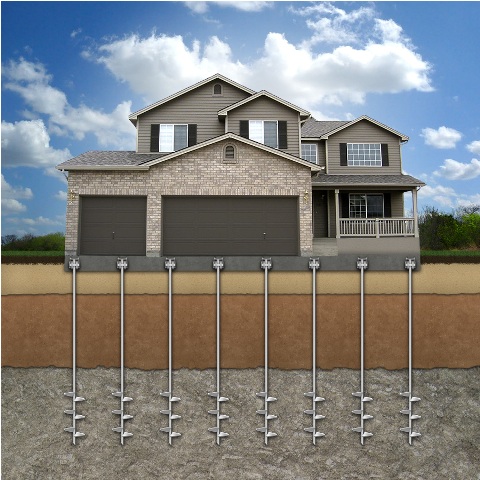
Helical piers work like a large screw, threaded into the soil with helical plates that distribute load along the pier's length rather than relying entirely on end bearing at a single depth. That installation method produces much less vibration than driven pier systems, which makes helical piers a common choice near existing structures, foundations with pre-existing cracking sensitive to vibration, or in tighter access situations where equipment for driven piers isn't practical.
Helical piers also allow for immediate load testing during installation — the installation torque correlates with the pier's load capacity, giving a real-time read on whether the pier has reached adequate bearing capacity as it's being installed, similar in principle to how push piers self-verify but through a different mechanism. This makes them a reliable choice for lighter residential structures and additions where a full push pier system would be more than the load actually requires.
We recommend helical piers based on structural load calculations and site conditions, particularly for smaller structures, porch and patio foundations, or situations where minimizing disruption to the surrounding property and structure matters.
📞 Call 888-619-6082